
Raising a concern with a social care service – What do you do?

In this article:
- How Healthwatch Lambeth can help
- How to raise a concern informally and how to make a formal complaint
- What to expect during the complaints process
- How to raise a safeguarding concern
- Where to go for further guidance on complaints, advocacy, and emotional support
Easy Read
For an Easy Read guide on how to complain about adult social care, click here:
Contacting us
Healthwatch Lambeth can help by:
- Providing information on the complaints process and the options available to you
- Providing contact details on where to raise a complaint
- Asking providers to clarify if there are aspects of the complaint process which are not clear
- Signposting you to external support
- Sharing your feedback with Adult Social Care or care services
Healthwatch Lambeth cannot:
- Investigate your complaint
- Advocate, e.g. fill out forms, help understand letters, attend meetings
- Provide specialist advice, e.g. medical, financial and legal advice
However, we may be able to signpost you to an organisation that can support with the above.
How to complain about social care services
Raising a concern informally
If you are worried about your care or the care of someone you know, the quickest way to get a response is to speak to the service about your concern informally.
- Care arranged by Adult Social Care – talk to your social worker or that of the person receiving the care. You can also file an appeal to review a social care decision.
- Care arranged with a private care provider, e.g. care home, supported accommodation, care agency – speak to the manager of the service.
Making a formal complaint
If your issue is not resolved by raising it informally, you may wish to file a formal complaint.
Anybody receiving care from a social care service can complain. You can also complain on behalf of someone else, if you have their permission.
- Complaints should be made to the service that arranged or provided the care, preferably in writing.
- If the care was arranged by Adult Social Care, you can complain to the local authority. The council should work with other agencies to answer your complaints if they include health care or care from other providers.
- All local authorities and care providers should have a formal complaints procedure, available on their website or by asking for a copy. It will outline how you should place your complaint, who you should speak to, and what timescales you can expect.
- You should make your complaint as soon as possible, preferably within 12 months of when the incident you are complaining about took place, or of when you became aware of the incident.
Complaints to Lambeth Adult Social Care
You can file a complaint with Lambeth Adult Social Care by filling an online form on their website. You can also complain by email, telephone, or in person.
The council should acknowledge receipt of your complaint within 3 working days. They aim to respond within 30 working days of receipt but may take 60 working days for complex complaints.
What to expect from the complaints process
Although different providers have their own complaints procedure, you can generally expect the following.
After placing your complaint
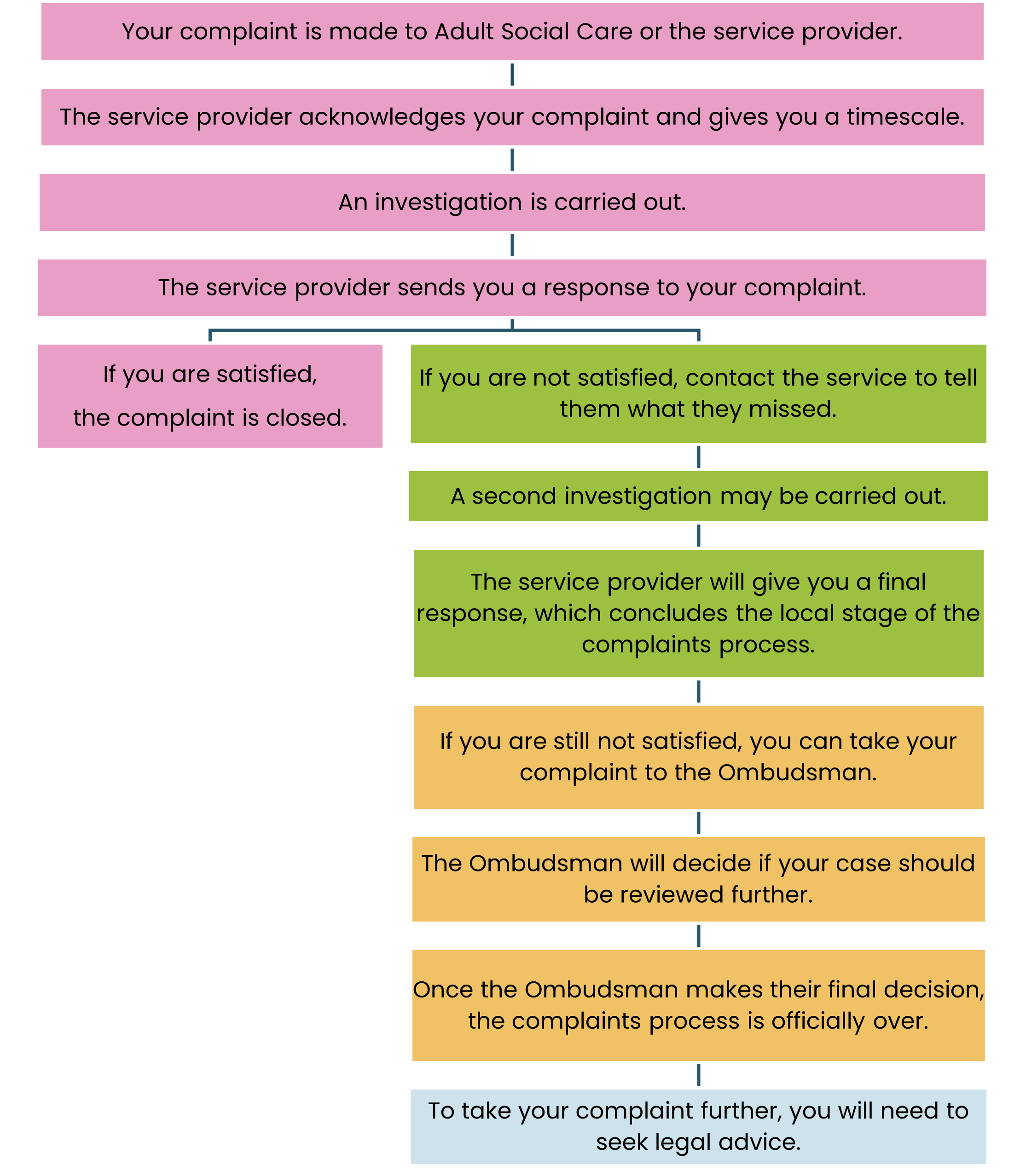
- The service provider will let you know that they have received your complaint and should advise you on a timescale.
- The service should keep you informed and let you know If the complaints team need more time.
- An investigation will be carried out, and you may be contacted for further details.
- You will then receive a response from the service on how your concerns have been investigated and any actions taken.
If you are not satisfied with the response
- You can contact the service provider and explain what you think they’ve missed. In response, further investigation into your complaint may be carried out.
- Once the service provider feels that they have done everything they can to answer your complaint, the service provider will give you a final response. This concludes the local stage of the complaints process.
After the local complaints process has ended, you can take your complaint to the Local Government and Social Care Ombudsman (LGO).
Complaining to the Social Care Ombudsman
The Ombudsman is independent from services and local authorities and can decide if your complaint should be investigated further.
When to complain to the Ombudsman
- You can complain about your own care or on behalf of someone else.
- If your complaint covers both health and social care, your complaint may be investigated jointly with the Parliamentary and Health Service Ombudsman.
- The Ombudsman can usually only review your case after you’ve concluded the local complaints process.
- You can complain early if the provider has not responded to your complaint after 16 weeks.
- You should complain to the Ombudsman within 12 months of when the original complaint was submitted.
What happens next
If the Ombudsman decides to investigate, they will gather information from you and the organisation about what took place. They will decide if the organisation was at fault and may make recommendations about how they can put things right for you.
After the Ombudsman makes their decision, the complaints process is officially over. If you wish to take your complaint further, you will need to take legal advice.
Find out more about how to complain to the Ombudsman
Here is a diagram showing the complaints process more clearly:
Other options available
Judicial reviews
If you think a social care decision was made unlawfully, you can legally challenge their local authority’s decisions or failures to act through a judicial review in the High Court, if there are grounds to do so.
A judicial review looks at if a decision was made lawfully, rather than if a decision was right or wrong. This means that the local authority can make the same decision again, if it does so in a lawful way.
A judicial review can proceed without someone going through the complaints process.
Find out more about judicial reviews
Sharing with the Care Quality Commission (CQC)
You can also raise concerns or report poor care to the Care Quality Commission (CQC). While they cannot investigate your complaint, your feedback will help them understand the quality of care being given by services.
Safeguarding
If you think an adult is at risk of being neglected or abused, or someone is neglecting or abusing you, please contact the Lambeth Adult Social Care team.
The quickest and most effective way to do this is by filling out the online form. You can also report it by phone at 020 7926 5555. Select Adults, then Option 3, for safeguarding matters only.
Find out how to report a concern about an adult
In an emergency, you should always call the police on 999. Alternatively, if it is not an emergency, call them on 101.
Further guidance
Advocacy
- Advocacy is free, independent support to involve people in decisions about their health, care and wellbeing. There are different types of advocacy, with different eligibility criteria. These include:
- Care Act Advocacy
- Independent Mental Health Advocacy
- Independent Mental Capacity Advocacy
- In Lambeth, advocacy services are provided by VoiceAbility. You can find out more on their website.
Visit the VoiceAbility website for information on advocacy
Complaints
The Local Government and Social Care Ombudsman has useful factsheets on social care complaints.
- How to complain about social care
- Complaints about adult social care arranged by councils
- Complaints about privately arranged adult social care
If you are a carer, Carers’ Hub Lambeth can provide advice and support through the complaints process.
Emotional support
For emotional support while you wait, you can contact:
- South East London Mind for general emotional support
- Samaritans, for immediate emotional support
- Lambeth Talking Therapies, if you are experiencing significant distress
- Citizens Advice, for advice on benefits, work, housing, and more
- Legal Aid and Law Centres, for legal advice
For signposting specific to your situation, please contact us.